
Front Steps
by Boris Mainaev
SHORT STORIES
12/9/20256 min read
A shadow hung over my soul, and I felt like moaning. This was not normal, for it had been years since I’d felt such loneliness and loss as I did now. It was as if a cloud had just veiled the sun.
“Wake up. It’s time to get up,” Mom’s sharp voice brought me back to reality, and I realized that it had all been a dream. My chest constricted, and it was hard to breathe. Without opening my eyes, I reluctantly got up and went to the bathroom. The smell of tin coming from the warm water with its gray soapy foam made me nauseous!
Behind me, Mom sighed again. Dad was already up and needed to use the bathroom; it was time for me to eat breakfast.
There was a bowl of oatmeal on the table and a breadbox containing—I was certain—six slices of bread: three white and three dark. Two apiece. I wondered, “What would happen were I to eat all the white bread now?”
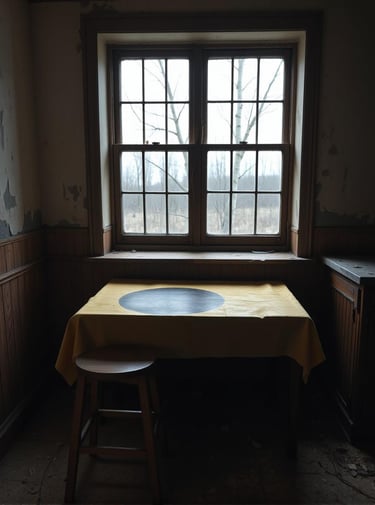
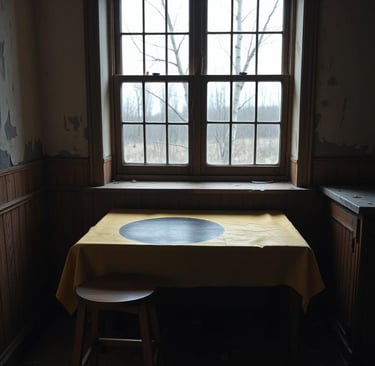
I carefully pulled my father's stool out from under the table and sat down. Mom put Dad’s cup on the corner of the table and looked at me. Her eyes displayed no emotion . . . I wanted to get up and look into them closely, for I was sure that from the point of view of their dark depths, I was sitting in my proper place—at the window, opposite the circle of burnt oilcloth.
Once, as I was just learning to walk, I stumbled at the table and Mom dropped a hot frying pan on the oilcloth as she moved to catch me. For the twenty years since then, I’ve been sitting in front of that black spot and been wishing that the frying pan had been the size of a table.
Mom thought about something for a moment, then put Dad’s cup back in its usual place and took out his plate and fork. She didn't seem to notice that I had taken his spot.
The water closet in the bathroom rumbled, and Dad appeared in the doorway. He walked silently toward his seat. His eyes seemed to look right through me, and I couldn’t tell if he even noticed that I was sitting on his stool. When the sleeve of his shirt touched my cheek, I hurriedly moved back to my stool. He sat down, and Mom placed my cup in front of me.
When the bread ran out, we all stood up, and I realized that I had made a firm decision. I shaved thoroughly, put on a fresh shirt, a blue speckled tie, and left the house, never to return.
Birds were singing, a grasshopper hidden in the grass was playing its violin. The clear blue sky was smiling at the world. I listened to the crunch of sand under the soles of my shoes and felt happy. On the very outskirts of the city, an empty little green bus stood at the stop.
“Where to?” I asked.
“That way,” the driver waved his hand without turning around. I sat down in the front seat as soon as he started the engine, and we drove off.
The road went up the mountains and down into the valleys. From time to time people filled the bus talking in indistinct voices; at times it rolled on completely empty. The sun had set. I felt so good that I didn’t want any bright lights or human noise. And the driver seemed to share my state of mind. The green dashboard lights created a glowing silhouette around him. I drifted in and out of sleep, and lost awareness of movement or stillness. It started to get lighter on the horizon and sunlight gradually broke through. The bus crested a few more hills and came to a stop. Then the driver opened the door, and without answering my question, waved his hand indistinctly.
The bright grass smelled of youthful freshness. Dewdrops winked
merrily from the foliage. An invisible bird chirped in the crown of a
branching tree, and a grasshopper played along. The wet sand
crunched beneath my soles. As I walked through the shadowy
streets, I kept thinking that I’d already seen it before.
“Now the sidewalk should make a turn and come to a stop at a
yellow transformer box . .”
Indeed, the road did curve, and I stopped in front of a cracked and
patched electrical box. Its rusty door hung on a single hinge, through
which a thin birch tree had sprouted. There was a single cloud in
the otherwise clear morning sky, and a cold thrill touched my chest. Now I walked slowly and looked around carefully. Everything reminded me of my hometown, only aged another ten years or more.
“It couldn’t be. Every city is cleaned, painted, and spruced up every spring.”
The road led me to a ramshackle house that had once been behind wooden fencing. Some broken bricks peeked out from under the dense grass. . . . All day yesterday, Sunday, Dad and I had been cutting bricks and filling the paths of our garden with them. It seemed that the owners here had done the same thing a long time ago. I stepped gingerly onto the rickety porch steps, and the creaky floorboards led me into the small kitchen. There was a table near the low window, covered with a yellowed oilcloth with a black circle, the mark of a hot frying pan. The door creaked behind me, and I looked back. A neatly dressed old woman stood on the threshold. A fine tremor touched her head. The dark eyes with fixed pupils were familiar to me.
“I’m sorry . . . Son.”
“What?!”
She held out her hand, and I almost shrieked—the coldness of her soft palm touched my cheek, froze over the scar that had crossed my left eyebrow since I was ten years old.
“Son, it’s been a long time since you’ve been home.”
“Mom?”
I fumbled for a stool, sat down, and realized that this was indeed my home. She took a familiar cup, plate, and fork out of the cupboard, and put a breadbox on the table with six slices of bread, three dark and three white. I ate my portion without hunger and stood up. At the door I looked back. She was looking at my stool and whispering something. I thought I heard her last words:
“Dad died ten years after his son left. . . .”
I cautiously descended the stubby steps. Heavy sand crunched beneath my feet. A clear blue sky shrouded the decrepit city. Birds sang, and a tiny fiddler soloed in the bright grass. A thick shadow fell across the road, and I looked up. The roof of the river warehouse was shielding me from the sun. Smoke billowed from the black stack of a small white steamboat at the wharf. As soon as I stepped onto the deck, a soft horn blew a funnel of steam into the sky and the boat departed. I looked back and saw a huge, gray-bearded man in a cap standing on the bridge.
“Where to?”
“Over there,” he waved his hand indistinctly.
I walked down to the passenger deck. There were wooden benches painted green on both sides. There was a girl sitting on one of them, looking out the window at the passing shore. I sat across from her and stared at the oily water. There were wood chips, empty bottles, and half-broken crates floating on it. Once, I saw a flap of brightly colored cloth. I thought it was a woman’s scarf; I looked up to ask the girl about it, but she was gone. . . . I felt good and calm. Maybe I was asleep, maybe I wasn’t. The steamer bumped its side against a pier, and I stood up. There was no one around the gangway. I went down to the shore and walked along the long road.
The road asphalt was cracked, overgrown with stunted grass and blue mushrooms. I walked through shady streets, past dilapidated houses. The path forked and ended in a pile of junk with bricks sticking out of it. To avoid getting my shoes dirty, I walked around the edge of the pile. Mud, mixed with last year’s leaves and dead grass, squished under my feet. The whole place was unfamiliar and looked like an abandoned cemetery. The path led to low shrubbery, behind which I could see a small, ramshackle house. I struggled through the thicket and approached the structure. The steps of the wooden porch had failed, the door was intact but had sagged and rubbed a groove in the floor. Creaking floorboards led me into a small room with cobwebs in the corners. There was a table by a low window, covered with a yellow and warped oilcloth with a black stain. I listened. The wind was whistling outside the window, and a dry birch branch beat against the glass. I sat down on a stool and realized that this was my house. And I was now alone in it.